Showing posts with label Muskets & Marshals. Show all posts

Tuesday, 19 November 2024

More rule tinkering

The temperature turned out to be lower than predicted as it was minus 4C when we got in the car to take the grandkids to school this morning so it was definitely a good call to bring the paints indoors from the Hinton Hut on Sunday!

However, this has not stopped me on my rule-tinkering journey and having put a lot of thought into it, and finally drawing up a useful spreadsheet (I know, I know, Goya was right, don't say it!) I've determined that too much tinkering is a bad thing.

I tried adopting a D6 rather than an average die for morale but strangely this didn't really make any difference. Then I tried amending various melee/morale factors but again it didn't seem to change the outcomes. I also fiddled around with the 'morale results' table but quickly abandoned that too.

Nice to see the Brunswickers on the table (they don't get out much). The Duke of Brunswick is old school and doesn't approve of tinkering with the rules or war.

I have made some changes though, the main one being to reduce the morale modifier for winning/losing a melee from 2 to 1 (I felt the +2 to winner and -2 to loser is just too much of a variable). I have also made the 'passage of lines' test easier to pass mainly so that supporting cavalry can more readily replace a unit already engaged to their front.

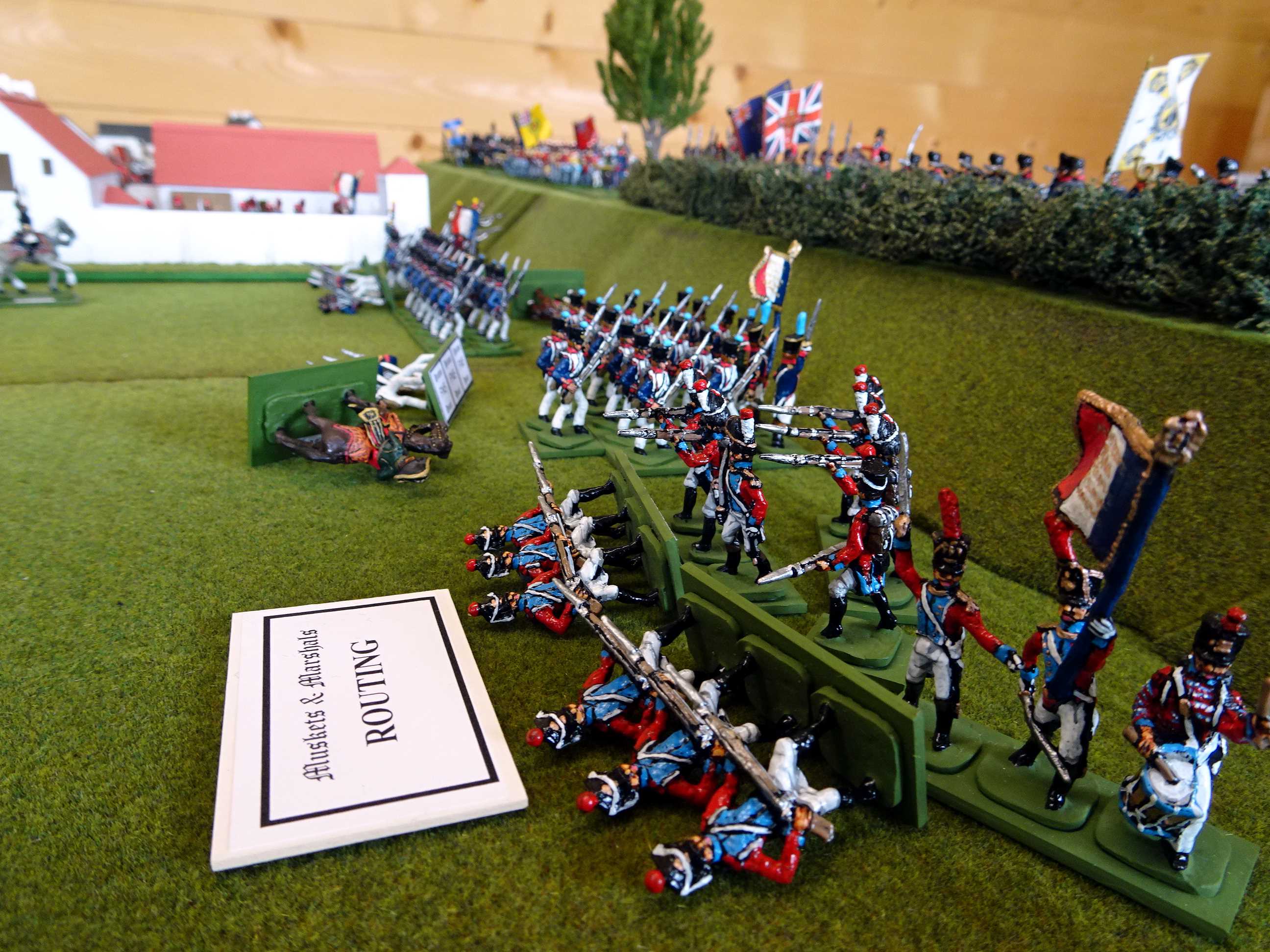
The French Guard Lancers have just lost the first round of melee (that's what you get for tangling with the Scots Greys) so they are going to attempt a 'passage of lines' with the supporting Cuirassiers. It went well but then the Cuirassiers lost too.

Apart from that there are some minor changes mostly sorting out anomalies and adding a bit more clarification to some of the not-so-well written stuff. In the end it has been enough to announce a Version 8 of the rules. If you would like a PDF copy then drop me a line (there is a contact email on my profile).

Friday, 15 November 2024

Tinkering with rules

It's generally not a great idea to tinker with rules but there have been a couple of things bugging me about my Muskets & Marshals rule set that I felt needed looking at. This is mainly the morale and melee factors for 'disordered' units and 'melee losers'.

I set-up a small game to try out my amendments. Goya would say that such things should be trialled on a spreadsheet and he's probably right but I do like to see the figures on the table.

If you have played the rules then you will know that it is very difficult for a unit that loses the first round of melee to win the second round because of the cumulative effect of these two factors. So I have been experimenting with toning things down a bit to give a less predictable result.

I'm also taking a look at fighting in buildings because I have an idea to try a small Dresden type game next year and there will have to be buildings in that.

I am concious though, that in the context of an eight-turn game where infantry melees only tend to happen in the last couple of moves, a dramatic result may not be a bad idea. At this stage the jury is still out.

I was taking a look at the weather for next week and thinking it may be wise to move my acrylic paints (and the PVA tube!) out of the cabin and into the house so I don't have a repeat of last year's calamity.


Sunday, 7 June 2020

Not quite Waterloo - Conclusion


With Saint-a-Mont fallen the Duke was now on a sticky wicket, the French could advance on the ridge without fear of flanking fire.

And advance they did!

The Guard Cavalry and Heavy Cavalry reserve pushed forward determined to take the initiative.

With a crisis point looming the Duke moved to the right to steady the ranks "Now, Mercer give them some canister!".

But by now many of the gunners had been picked off by French skirmishers and nothing could halt the advance of the Guard.

The Brunswick Horse Artillery did cause some execution amongst the enemy cavalry but it was not enough to turn the tide. 

All along the line the allies were taking heavy casualties and even poor Lord Hill was down.

One small success for the allies - the Swiss were sent packing but this was against the run of play.
.
As the 45th and 105th ligne swept up on to the ridge.

On the opposite flank the Young Guard and Guard Marins prepared to charge.

The Duke ordered the Guards forward but it was not enough "Gentlemen, the last one back to Brussels is a rotten egg!".

The Guard Marins storm the ridge and see off the Brunswickers - another glorious victory for the French and not a single soldier of the Old Guard with so much as a scratch on him!

It was fun to get all the figures out on the table and play through the game although a shame to see the Duke trounced once more, I should have let the Prussians arrive!

Thursday, 4 June 2020

Mini not quite Waterloo


This week I found that I was a year older but on the plus side was pleased to receive by way of a gift, more TSS terrain units together with some custom cut hills. The hills include a 4-foot ridge which provides a serious defensive position that the Duke was keen to take advantage of straight away. Napoleon was equally keen to try out his latest Guard unit and so deployed the entire Grande Armee ready to attack.

The view from the allied ridge across a shallow valley towards the French lines. Does anything look vaguely familiar to you?
The emperor had placed a grand battery on the opposite side of the valley backed up by his heavy cavalry in reserve.
Wellington held the Guards in reserve behind his ridge (the ridge looks quite massive in this photo but is actually only 40mm high).
Ok, this is the photo you've been waiting for - the massed ranks of the Imperial Guard.
The French infantry wait patiently for the order to advance whilst the Grand battery pounds the allied line. That's Grouchy nearest the camera - surely some mistake? 
On the French left flank the Guard is screened behind three line battalions including Poniatowki's Poles.
Things get underway with a spirited attack on Hougo-Sainte.
At the same time, following an heroic resistance, the Prussian Jagers are forced out of Saint-a-Mont

Sensing an opportunity Napoleon is quick to order a general advance.

While the Grand battery continues to pound away just like the good old days in the 60s.

There's not much the British can do except stay nailed to their ridge and grin and bear it.

Ominously, behind the French front line, their cavalry are massing and moving forward.

To be continued…


Thursday, 2 April 2020

More rule musings

When Goya last came over to help me playtest my rules (was it only 3 weeks ago?) he asked me what I wanted to achieve through the testing. This was a good question and having thought about it since I realised that I was trying to change too many variables at the same time to come to any proper conclusions. As a result, I decided to go right back to square one and play through a scenario with the existing rules to see where any problems might actually lie on the ‘if it ain’t broke don’t fix’ it principle.

One other thing Goya said was that in any given situation I should look at what the likely outcome would be and see if the rules match this in play, clever fellow that Goya but then he is a scientist. So, I set up the table with a French attacking force outnumbering a defending allied force by 2:1, no hills, no buildings just a straightforward set up. All things considered this looked like a scenario that the French should win.

There were 6 French columns with 4 batteries supported by cavalry and skirmishers. The allies had 2 British line units plus the Brunswickers, 2 batteries of artillery, the light dragoons and some rifles.
The First couple of turns the French concentrated on counter-battery fire that proved very effective so that the allied gun-line was neutralised. On turn 3 the French columns advanced covered by a skirmish screen that got the upper hand over the rifles.
The columns charge forward and take fire. I allowed 2 columns to charge each unit in line as my previous restriction on this seemed unjustified.
The French succeeded in charging home everywhere and won the resulting melees.
On the right the Cambridgeshire's were routed and poor Alten was felled. As you can see the new 24th ligne had a hand in this.

So, the French did win as expected but the wider scope of the game including the use of skirmishers and the larger number of guns opened up some interesting alternatives. It occurred to me that the rules as they stand are pretty much to my liking but maybe the only thing that needs tweaking is the morale rules in relation to unit losses (another idea of Goya’s). I played the scenario again with just this change -

Strength Factors for Morale
Infantry – 21 or more figures remaining in unit +1
Cavalry – 10 or more figures remaining in unit +1
Infantry – 16 or fewer figures remaining in unit -1
Cavalry – 7 or fewer figures remaining in unit -1

This time the French had more problems closing with the lines. This was helped by the Rifles gaining ascendancy over the Voltigeurs and also by some impressive British volley fire.
On the right the Cambridgeshire's were routed again but a spirited charge by the Light Dragoons saw off the 9th legere.

The result was much closer with more of the attackers becoming disordered and the game played out nicely. It was interesting to see how the subtle change to the morale Strength factors influenced play. I need to do more playtesting but then I do seem to have some time on my hands.

Sunday, 15 March 2020

A Grenadier and more rule playtesting

Not much painting progress recently other than this test-figure for the Grenadier company of the 24th line. The figure is FN/237 Grenadier (marching).


On Wednesday Goya came over to the Hut to help me with the continuing playtesting of the tweaks for my rules Muskets & Marshals. We ran through a couple of small scenarios that turned out to be surprisingly good fun to play.

Here come the French again taking on an allied line on a ridge - should be a piece of cake.
The attacking French columns were all forced into line but were eventually successful in the centre and right flank. On the left flank the 45th ligne were routed by a spirited counter-attack from the Black Watch. We both agreed that the rule changes resulted in an interesting little game.
After lunch we swapped sides and his time the French were tasked with attacking an Austro-Russian force with one flank anchored on a village.
The action developed into a pell-mell fight with units shooting and charging all over the place. It was good fun but we didn't really get to test the rule changes so much in this one. My main conclusion is that the rules are pretty good as they stand but a bit more work on morale may nail it.

For the record these are the amendments we tried out:

Morale

+1 advancing in column
+1 charging (not uphill)
-1 unit receiving 4 or more casualties in a single turn

If a column declares a charge on a line and the line passes its morale test with good morale throw 1 x normal die:

1, 2 or 3 the column must HALT and deploy into line instead of completing a charge.
4, or 5 continue with the charge as normal but do not add +1 for charging to the unit morale test score.
6 continue with the charge as normal.

A+ troops +1 to die roll

Sunday, 23 February 2020

Goya’s theory – part 2

Thanks to everyone who chipped in with suggestions on my last post, there were many interesting opinions and rule ideas given. One of the ideas I liked was that of making the attacking column deploy into line if the defenders looked too hard. To simulate this, I made the following rule adjustments –

1. If a column declares a charge on a line and the line passes its morale test with good morale the column must halt and deploy into line instead of completing a charge.
2. Remove the +1 morale bonus for charging units
3. A British volley is defined as 6 or more figures firing at close range (not 12 as previously, to allow disordered units to still have a morale effect on chargers).

The French come on in the same old style, except that somehow they seem to have shot Picton!
The Swiss make a charge on the Brunswickers who become disordered following their morale check. However, after receiving a half-effect volley and canister fire the Swiss are stopped in their tracks.
On the other flank, the Black Watch have survived their 'unit charged' morale check forcing the 9th legere to deploy into line.
Next move and its the turn of the Poles and 45th ligne to charge.
Both are disordered and stopped by the enemy musketry. The French will have to settle for a fire-fight.

It made for a very interesting little game and I liked the subtlety of changing formation while the next column moved up to have a crack at the line. It was quite satisfying to see the French attack stall and then fail, however I do wonder if this has tipped things too far in favour of the defence. When I get more time, I will try a game with tweaked morale factors only.

Thursday, 20 February 2020

Goya's theory

Goya noted some time ago that in my rules Muskets & Marshals columns will invariably succeed in an attack against line. Being an admirer of Wellington (he has every army in 20mm vintage except French) he found this a bit hard to swallow and even went as far as to send me a clever spreadsheet that would calculate the odds. I can’t remember the outcome exactly, but I think it was that columns would triumph 9 times out of 10.

I do agree that in a straight-out column against line scenario this is probably correct but in full blown battle where other factors interfere my hope is that the odds are better. I’m heartened to recall that in the Vintage Waterloo game 7 units of Imperial Guard failed to dislodge the British from the ridge. Ok, so the British had a plus for being on a hill and another for being behind a hedge (never did understand where that hedge came from) and had suffered very few casualties from the French artillery but that’s my point – other factors come into play that stop the outcome being totally predictable.

So, to prove or disprove Goya’s Theory I set up the table to play a small column vs. line scenario. An Allied brigade in line held a ridge facing a French division in column trying to force them off. This is how it played out -

Uxbridge has a brigade of British infantry in line on a ridge with the Black Watch on the right and Brunswickers on the left. The British have one battery of field artillery. Across the valley Eugene has four columns of French infantry supported by two gun batteries.
By the time the French get within charging distance they have taken quite a few casualties but their morale is holding well. The British haven't taken a single casualty yet.
Drat, that Goya is right! The Swiss have successfully charged and routed the Brunswickers whilst on the opposite flank the 9th legere have broken the Black Watch. In the centre the Poles have been disordered by some rather devastating canister fire while the 45th ligne remain in good order. 

I played the game through 5 times with a total of 10 French column attacks taking place. The columns succeeded in breaking the lines 7 times, a slightly better result for line than the theory suggested but still showing that Goya is basically correct.

I plan to expand the test scenario to include other factors like more artillery, cavalry threatening the flanks of the columns, skirmishers etc. to see if the odds can be evened up. I’m a bit loath at this stage to tinker around with morale and melee factors as this could have unforeseen effects on the balance of the game elsewhere.